


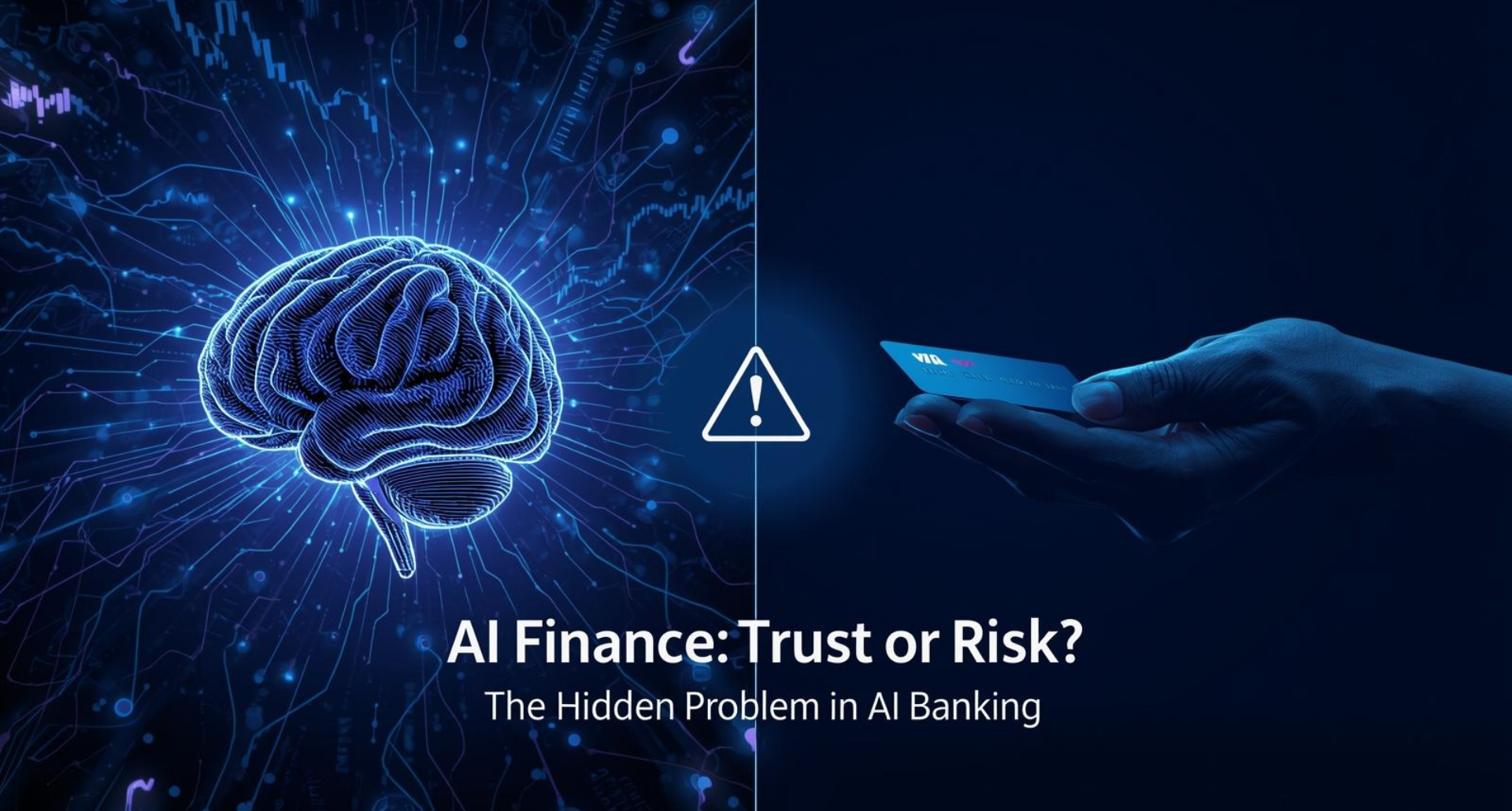
Banks, fintech startups, and investment firms are embracing AI to improve efficiency, reduce costs, and provide faster financial services.
But alongside these benefits comes a growing concern.
As algorithms increasingly make decisions about loans, investments, and risk assessments, a fundamental question emerges:
Can we truly trust AI to manage our money?
The answer is far more complicated than it first appears.
Over the past decade, AI has moved from experimental technology to a core part of financial infrastructure.
Financial institutions now use AI in areas such as:
Fraud detection systems
Algorithmic trading
Credit risk evaluation
Customer service chatbots
Automated investment platforms
Machine learning models can analyze massive datasets in seconds, detecting patterns that human analysts might miss. This ability makes AI particularly powerful in finance, where markets generate enormous volumes of data every second.
For example, AI trading systems can analyze market signals, news sentiment, and historical price movements simultaneously to execute trades faster than any human trader.
This speed and analytical capacity create clear advantages.
But they also introduce new risks.
Despite its capabilities, AI still faces a significant trust gap in financial services.
One of the biggest issues is algorithmic opacity.
Many AI models operate as “black boxes.” They produce decisions without clearly explaining how those decisions were made. When a system denies someone a loan or executes a high risk trade, understanding the reasoning behind that decision can be extremely difficult.
For consumers and regulators, this lack of transparency creates a serious problem.
Financial decisions affect people's livelihoods, businesses, and long term financial security. Without clear explanations, trusting AI systems becomes challenging.
Another major concern involves algorithmic bias.
AI systems learn from historical data. If the data used to train these systems contains biases, the AI may replicate or even amplify those biases.
In financial contexts, this can lead to issues such as:
Biased loan approvals
Discriminatory credit scoring
Unequal risk evaluations
Several studies have shown that poorly designed financial AI systems can unintentionally disadvantage certain demographic groups.
As a result, regulators around the world are increasingly scrutinizing how financial institutions deploy AI.
Financial AI systems also create systemic risk.
When many institutions rely on similar algorithms, unexpected market events can trigger rapid automated reactions across the financial ecosystem.
Algorithmic trading has already demonstrated this risk in events like sudden market crashes where automated systems react simultaneously to market signals.
In extreme cases, AI driven trading strategies can amplify volatility instead of stabilizing markets.
This raises important questions about how much control should be delegated to automated systems.
Governments and financial regulators are now working to address these concerns.
New frameworks are being developed to ensure that AI systems used in finance meet strict standards for:
Transparency
Accountability
Data governance
Risk management
Regulatory bodies in regions such as the United States, Europe, and Asia are exploring rules that require financial institutions to explain AI based decisions and ensure fairness in automated systems.
These efforts aim to balance innovation with consumer protection.
Despite these challenges, AI is unlikely to disappear from finance. In fact, its role will almost certainly expand.
The real question is not whether AI will shape financial services, but how it can do so responsibly.
Building trust in AI driven finance will require:
Transparent algorithms
Human oversight in critical decisions
Strong regulatory frameworks
Continuous auditing of AI systems
Financial institutions that successfully address these issues will likely gain a major competitive advantage in the years ahead.
AI is reshaping finance at an extraordinary pace. It promises faster services, smarter risk analysis, and more efficient financial markets.
Yet trust remains the defining challenge.
Without transparency, accountability, and ethical safeguards, the very systems designed to improve financial decision making could undermine confidence in the financial system itself.
The future of AI driven finance will therefore depend on one critical factor:
Whether technology can earn the trust that finance ultimately requires.
No comments yet. Be the first to comment!











Leave A Reply