


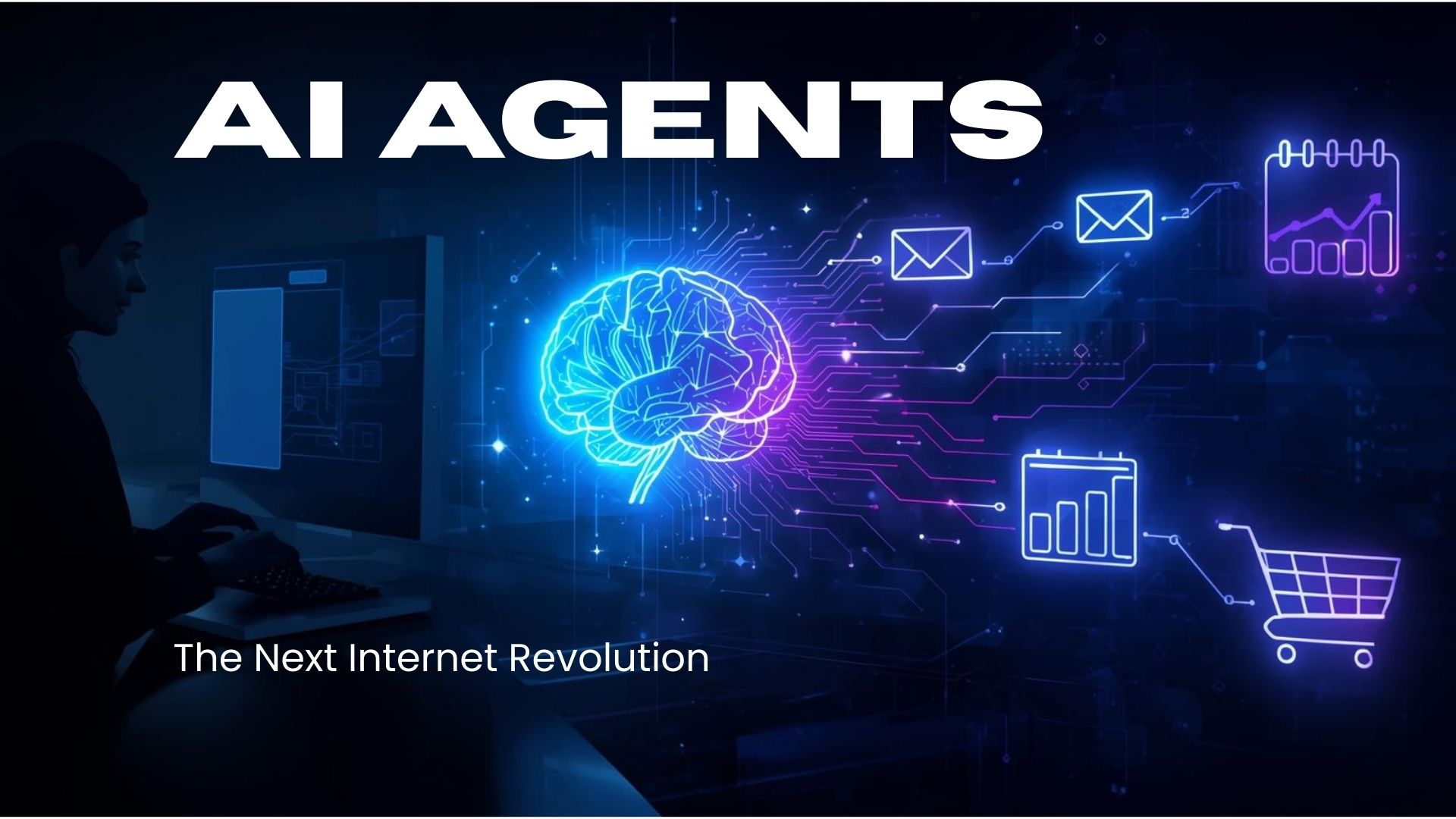
Artificial intelligence has already transformed how people interact with technology. Chatbots, recommendation systems, and generative AI tools are now part of everyday digital life.
But a new development is rapidly gaining attention in the technology world: AI agents.
Unlike traditional AI tools that simply respond to prompts, AI agents are capable of planning actions, completing tasks independently, and interacting with software systems with minimal human supervision.
Many researchers and technology companies believe that AI agents could represent the next major shift in how the internet works.
Instead of humans performing every step in a digital workflow, intelligent agents could handle complex processes automatically.
An AI agent is an autonomous software system designed to perceive its environment, make decisions, and take actions in order to achieve specific goals.
In practical terms, this means an AI agent can:
• Understand user instructions
• Plan multi-step tasks
• Interact with digital tools
• Adapt based on results
• Continue working until the task is completed
This makes AI agents fundamentally different from simple chatbots.
Traditional chatbots provide answers. AI agents perform actions.
For example, instead of simply suggesting travel options, an AI agent could:
• research flights
• compare prices
• book tickets
• add the trip to your calendar
• notify you about updates
All of these steps could happen automatically.
AI agents combine several advanced technologies to function effectively.
These typically include:
Large Language Models (LLMs)
Language models provide reasoning, planning, and communication capabilities.
Tool Integration
Agents can interact with software tools such as APIs, databases, browsers, and productivity apps.
Memory Systems
Agents store information about previous interactions, improving decision making over time.
Planning Algorithms
AI agents break complex objectives into smaller tasks and execute them sequentially.
This combination allows agents to operate more like digital workers rather than simple AI assistants.
AI agents could fundamentally change how people interact with computers and the internet.
Instead of navigating websites, filling forms, or switching between apps, users could simply describe a goal.
The agent would then handle the process automatically.
For example:
• Planning a business trip
• Managing emails and scheduling
• Conducting market research
• Running marketing campaigns
• Monitoring financial transactions
In many cases, agents could perform tasks faster and more accurately than humans.
This shift could dramatically increase productivity across industries.
Companies are already experimenting with AI agents in areas such as:
Customer Support Automation
Agents can resolve customer queries, manage tickets, and escalate issues when necessary.
Software Development
AI coding agents can generate code, debug issues, and test software.
Marketing Operations
Agents can analyze campaign data, adjust budgets, and optimize advertisements automatically.
Business Process Automation
Complex workflows across departments can be handled by AI driven systems.
Because of these capabilities, many experts believe AI agents could become the next generation of enterprise software.
Despite their potential, AI agents also raise several important challenges.
Reliability Issues
Autonomous systems can make mistakes, especially in complex environments.
Security Risks
Agents interacting with financial systems or sensitive data require strong safeguards.
Control and Oversight
Organizations must ensure that AI agents operate within defined boundaries.
Ethical Concerns
Autonomous systems making decisions could create accountability questions.
Addressing these concerns will be critical as AI agents become more widely adopted.
The development of AI agents is still in its early stages, but the momentum is growing rapidly.
Technology companies, startups, and research labs are investing heavily in autonomous AI systems.
Over the next few years, AI agents could evolve into:
• fully autonomous digital assistants
• intelligent business operators
• automated research analysts
• AI powered productivity systems
If this vision becomes reality, interacting with computers may shift from manual navigation to goal based instruction.
Users will simply describe outcomes, and intelligent systems will execute the work.
AI agents represent one of the most important developments in artificial intelligence today.
By combining reasoning, planning, and automation, these systems move beyond simple responses and begin to function as autonomous digital operators.
If the technology continues to mature, AI agents could redefine how the internet works, how businesses operate, and how people interact with software.
In many ways, they may mark the beginning of the next major revolution in the digital world.
No comments yet. Be the first to comment!









Leave A Reply